
If you’ve taken an Alaska cruise, chances are you visited the dramatic fjords that are home to many glaciers. I did this in 2009 (I even got a short story out of it). The other day on NPR, I heard about a tsunami in one of these fjords, but I missed the real context.
The “megatsunami” happened last year in Tracy Arm and was caused by a landslide that itself was caused by the melting and retreating South Sawyer glacier. Now scientists have analyzed what happened and it’s pretty horrifying (a cruise ship had been in that spot the day before).
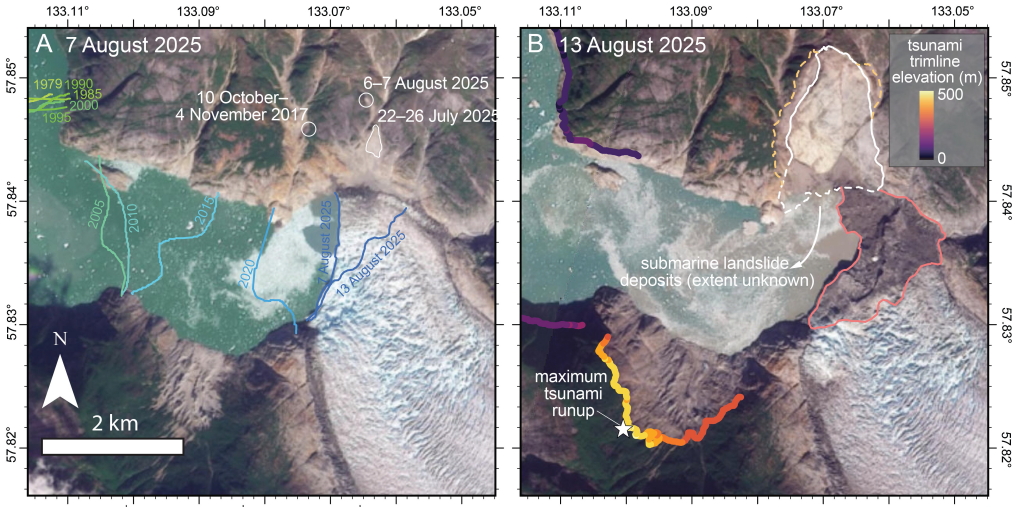
The image above shows how the glacier has retreated over the years. Almost no changes from 1979 to 2000, but then dramatic retreat, including 2010, the year after I visited Tracy Arm. At the time, the naturalist on our small ship pointed out how the glaciers had retreated over just the past five years, as shown by the exposed rock that had once been covered in ice.
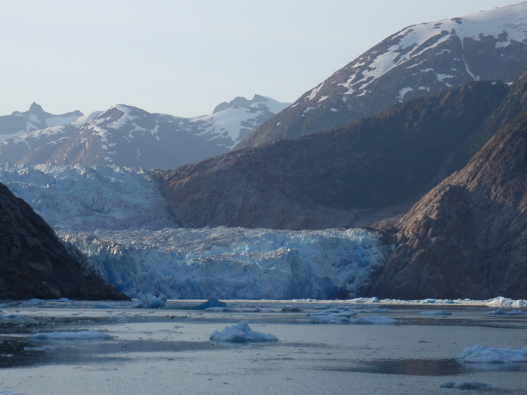
Our ship got within a quarter mile of the glacier, which was some 400 feet high. I remember the rifle-crack sounds as chunks broke off. Glaciers move (at, you know, a certain pace) and the raw edge is always changing and breaking, leaving “burgy bits” to float in the beautiful green water. Seals (aka orca sausages) lolled on floating blocks of ice. Some “bits” looked like deep blue freezer pops. A lone goat clung high on the fjord wall, a small cream-colored dot.
Turns out the glacier not only filled the fjord from side to side. It was also holding back the land. And when the support was gone, boom! Down came tons of rock. The resulting wave crashed up the opposite rock face a good 1,500 feet. In two minutes, 62 million cubic meters of material crashed into the fjord. I’d convert that to some nonmetric unit, but the scale is simply too big to fathom. Does 81 thousand cubic yards mean anything to you? Not to me. Let’s just say it’s a lot.
The resulting wave, after it climbed the opposite wall, crashed back down and a wave initially 328 feet high continued out the fjord, sweeping almost all vegetation off Sawyer Island as well as the sidewalls as it traveled, swamping some campers’ gear, and eventually reaching the mouth of Tracy Arm, where a cruise ship noticed…something off.
If there had been a cruise ship near the glacier at the time, well, it would not have been a fun ride. That’s the main takeaway from the study, and Alaska does a lot of monitoring around the state for earthquakes and now landslides caused by melting glaciers. I, for one, did not have that on my 2026 bingo card.
That no one was hurt was largely due to it happening at 5:26 a.m. (back in 2009, my ship arrived at South Sawyer by 7:30). The campers, who had set up well away from the shore, woke to water passing by their tent.
The risk to tourists on a cruise ship is actually kind of petty when compared to the real danger from melting glaciers around the world—threatening freshwater supplies in the Himalayas and Andes, raising sea levels, altering ocean currents.
I went to Alaska to see glaciers before they are gone. Then I wrote some novels that take place afterwards. Be nice if they remained fiction.
Sources:
Waiting to Fail: Research about 2025 Alaska landslide and tsunami warns that more are coming (University of Alaska Fairbanks Geophysical Institute)
Megatsunami in Alaska’s Tracy Arm was the second-highest ever measured (Alaska Beacon)
The full study in Science: A 481-meter-high landslide-tsunami in a cruise ship–frequented Alaska fjord
 Elaine Burnes
I just watched a short video about it:
It would have been an amazing sight… from a distance. It wouldn’t be fun to be close to it.
I wonder if cruise ships will continue to travel the fjords now.
That was interesting! Thanks for posting it. I think they had stopped Tracy Arm tours last year, but I don’t know what cruises are doing overall. Not something I’d want to risk. Would love to have been a bird flying overhead, though!